
The five cosmetic glass bottle types that cover almost every beauty launch are dropper bottles, pump bottles, spray bottles, roll-on bottles and wide-mouth formats. Dropper bottles alone accounted for 37.1% of glass cosmetic bottle revenue in 2025, which shows how much of the category is built around serum and facial oil packaging. The choice is never purely aesthetic: glass colour, neck finish and closure must match your formula’s viscosity, light sensitivity and filling line. This guide covers every type, shape, size and MOQ you should confirm before you approve a mold.
Quick answer: Use dropper bottles for serums, facial oils and essential oils; pump bottles for lotions, foundations and cleansers; spray bottles for toners, mists and fragrance; roll-on bottles for spot treatments and perfume oils; and wide-mouth or jar formats for balms and thick creams. Match glass colour – clear, amber, frosted or opal – to how light-sensitive the formula is, then confirm the neck finish before artwork is signed off.

What Are the Main Cosmetic Glass Bottle Types?
Almost every prestige skincare, fragrance and personal care launch falls into one of five formats. Each of these cosmetic glass bottle types decides your filling line, closure, decoration method and – critically – the minimum order quantity you will have to commit to.
| Bottle type | Best for | Typical capacity | Closure |
|---|---|---|---|
| Dropper bottle | Serums, facial oils, essential oils, hair oils | 15–50 ml | Pipette + screw collar |
| Pump bottle | Lotions, cleansers, foundations, hand care | 30–200 ml | Lotion or serum pump |
| Spray bottle | Toners, face mist, fragrance, setting spray | 10–120 ml | Crimp or screw atomiser |
| Roll-on bottle | Spot treatments, eye serums, perfume oils | 5–15 ml | Roller ball + screw cap |
| Wide-mouth / jar | Balms, butters, masks, thick creams | 15–250 g | Screw lid + liner |
The market data shows how concentrated that demand is. Dropper bottles hold the largest product-type share, the 30–50 ml band is the single biggest capacity bracket, and skincare absorbs almost half of all demand:
Glass cosmetic bottle market at a glance
- Market size: USD 3.3 bn (2025) → USD 3.5 bn (2026) → USD 4.7 bn (2033), a 4.3% CAGR from 2026 to 2033
- Asia Pacific: 42.0% of global revenue in 2025
- Dropper bottles: 37.1% of product-type revenue in 2025
- 30–50 ml capacity band: 34.9% share in 2025
- Skincare applications: 46.1% of demand in 2025
Source: Grand View Research, Glass Cosmetic Bottle Market (2026–2033)
Fragrance tells a similar story in a separate data set. The cosmetic and perfumery glass bottle packaging market is projected to move from USD 2.59 billion in 2025 to USD 2.73 billion in 2026 and USD 3.42 billion by 2031, at a 4.61% CAGR, according to Mordor Intelligence – and perfume alone commanded 45.32% of that market in 2025. That makes perfume and fragrance bottles the most decorated and most competitive corner of the category.
Cosmetic Glass Bottle Shapes: Round, Square, Cylinder & Specialty
Once the cosmetic glass bottle types are narrowed down, shape becomes the next decision: it drives shelf presence, label area and forming tolerance. Six profiles cover the vast majority of briefs:
| Shape | Typical use | Why brands choose it |
|---|---|---|
| Round / Boston round | Serums, oils, lotions | Widest closure compatibility, lowest tooling cost |
| Square / rectangular | Fragrance, premium skincare | More label area per ml and efficient shelf packing |
| Slim cylinder | Serums, essences, travel kits | Minimalist K-beauty aesthetic in the hand |
| Oval / teardrop | Nail polish, personal care | Feminine silhouette with easy cap grip |
| Hexagonal / faceted | Fragrance, attar, gift sets | Instantly recognisable on a retail shelf |
| Wide-mouth round | Balms, masks, body butters | Accepts a spatula and a tight sealing liner |
The Boston round is the workhorse: a wide, stable base and straight shoulder make it easy to label and compatible with almost every dropper, pump and atomiser, which is why it carries the lowest minimums. Hexagonal and faceted profiles cost more because they demand tighter forming tolerances, but they give fragrance brands a silhouette that reads at a glance – see how a 10 ml hexagonal refillable perfume bottle uses that effect at miniature scale.

How to Match Bottle Type to Your Formula
Start with viscosity and oxygen sensitivity, not with a shape you liked on a mood board:
- Watery to thin (toners, essences, fragrance): spray bottles or crimp-neck flacons. Anything thicker than water will clog a fine-mist actuator.
- Thin serums and oils: dropper bottles. The pipette gives dosage control, which matters for actives sold at premium prices.
- Oxidation-sensitive actives: pump or airless formats. Vitamin C, retinol and peptide formulas lose potency in contact with air; Baralan’s DEA 2.0, a glass-based airless container launched in March 2026, shows the idea moving into glass.
- Lotions, cleansers, foundations: pump bottles, usually 30–100 ml, for metered dosing and hygienic use.
- Spot treatments and perfume oils: roll-on bottles. No spill risk, precise application, ideal at 5–15 ml.
- Balms, butters, masks: wide-mouth formats that accept a spatula and a sealing liner.
One further constraint: filling line compatibility. Confirm neck diameter, neck height and bottle weight with your co-packer before tooling is approved – changing a profile after the mold is cut costs far more than changing a closure.
Glass Colour, Finish and Decoration Options
Most cosmetic glass bottle types can be produced in any of the colours below, and colour is a functional decision as much as a branding one:
- Clear flint: maximum product visibility. The default for serums, toners and gift sets.
- Amber: the standard choice for light-sensitive essential oils and botanical extracts.
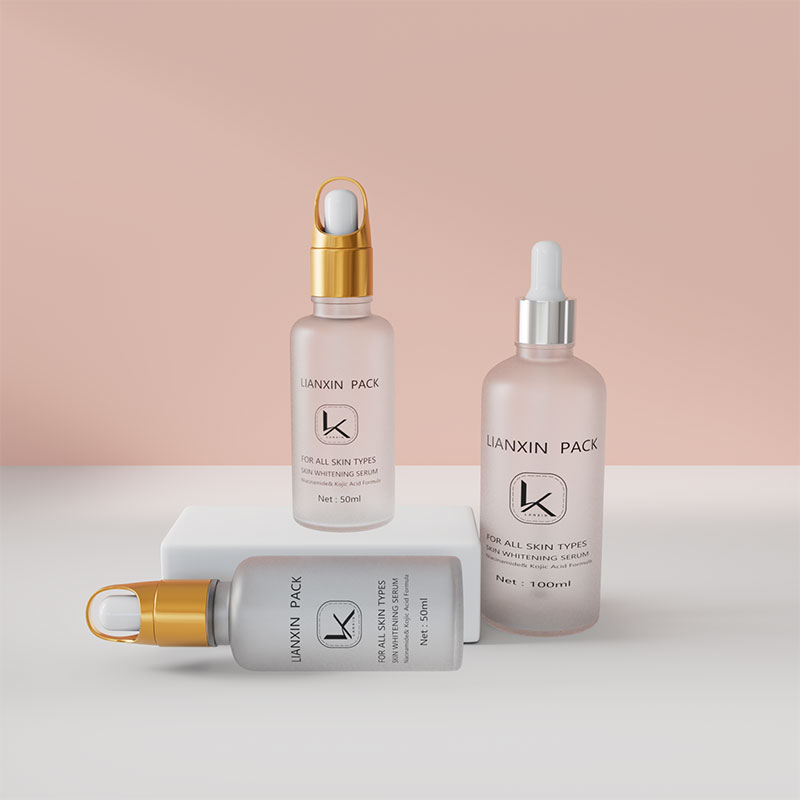
- Frosted: a soft-touch look that diffuses colour and hides minor surface scuffs. Produced by acid etching or a sprayed matte coating.
- Opal / white: an opaque base that shields the formula from light and makes pastel colours read cleanly – see a white glass cosmetic bottle set with printed branding.
- Sprayed and gradient: full-coverage colour in matte or gloss, including two-tone gradients that photograph well for e-commerce.
- Electroplated and metallised: the mirror-gold and chrome finishes usually applied to caps, collars and shoulders.
Decoration is where new brands most often overspend. Every technique carries a setup cost spread across the run, so screen printing and hot stamping only make sense above roughly 2,000 units, while a one-colour label stays cheaper below that. A matte or glossy black glass lotion bottle set shows the other end of the spectrum: coating plus printing plus a matched jar, which buys shelf presence but lifts MOQ and unit cost.
Cosmetic Glass Bottle Sizes and Neck Finish Basics
Capacity should follow the dosage ritual, not the other way round. Here is how the common bands map to products:
| Capacity | Typical products | Why this size |
|---|---|---|
| 5–15 ml | Perfume samples, roll-ons, eye serums | Trial, travel and gift-with-purchase formats |
| 15–30 ml | Face serums, facial oils, treatments | About one month of daily use |
| 30–50 ml | Serums, lotions, foundations | The largest capacity band (34.9% share, 2025) |
| 50–120 ml | Lotions, toners, cleansing water | Daily-use volumes with pump or sprayer |
| 120–250 ml / g | Body care, hair oils, creams, masks | Value sizes, often paired with a jar |
Sizes mean nothing without the neck. Two neck families cover almost everything:
- Screw neck: the bottle is filled, then the closure is screwed on and the consumer can refill it. Most droppers, lotion pumps and roll-ons use this format, and a standard neck profile lets you switch closures on the same glass body – a glass dropper bottle and a glass lotion pump bottle can share one shape.
- Crimp neck: the pump or sprayer is crimped onto the glass after filling and cannot be removed without damage. This is the norm for fragrance and many sample formats because it is tamper-evident and leak-resistant.
Neck profiles follow standard naming – for example the SNI 15 screw neck used on Bormioli Luigi’s 100 ml Edge flacon launched in November 2025 – and in practice, GPI/SPI-style dimension codes. Always send your chosen closure to the glass supplier so both are dimensionally verified together: even a small mismatch in neck height or thread pitch can cause leaks in transit.

What Is the MOQ for Custom Glass Bottles?
Minimum order quantity is the most common reason a launch stalls. It is driven by mold type and decoration:
| Order scenario | Typical industry MOQ | What drives the number |
|---|---|---|
| Stock mold, no decoration | 300–5,000 pcs | Tooling already exists; only filling and packing setup |
| Stock mold + frosting or spray coating | 1,000–5,000 pcs | Coating or colour batch setup per run |
| Stock mold + screen print or hot stamp | 2,000–10,000 pcs | Print plate or foil setup per design |
| New private mold | 10,000–50,000+ pcs | Mold engineering plus forming-line trials |
Industry benchmarks are wide. Prestige fragrance programmes built on bespoke flacons commonly run on 50,000-piece minimums with 60-day lead times, while specialist suppliers court independent beauty brands with 1,000-piece minimums and 30-day prototypes, according to Mordor Intelligence. Lansenpack’s standard MOQ for glass containers is 5,000 pieces, with flexible terms for growing brands – stock-mold designs keep that number low because tooling is already amortised. Whatever the figure, budget for a physical sample round before mass production: it is the cheapest way to catch a neck, colour or decoration mismatch.
How to Choose a Glass Cosmetic Bottle Supplier
Once you know which cosmetic glass bottle types fit your formula, shortlist suppliers on capability and compare quotes on a like-for-like basis:
- Mold library: does the supplier hold stock molds in your size band, or will every design trigger new tooling? Start from the glass cosmetic bottles range and check whether your target shape and capacity already exist.
- In-house decoration: spraying, frosting, printing and metallisation under one roof removes the most common source of launch delay.
- Closure pairing: confirm that droppers, pumps and atomisers can be matched to the neck in one place. Tiny formats such as the sample perfume bottles range are where neck compatibility bites hardest.
- Quality documentation: AQL inspection reports, migration and heavy-metal test results, and a documented inspection routine as standard.
- Comparable quotes: ask for pricing at two quantities – say 5,000 and 10,000 pieces – with glass, decoration, closure and packing listed as separate lines. A bundled quote hides the line you will actually negotiate.
Frequently Asked Questions
What is the most popular type of glass cosmetic bottle?
Dropper bottles are the most requested of all cosmetic glass bottle types, holding a 37.1% revenue share of the global glass cosmetic bottle market in 2025 – ahead of pump bottles, spray bottles, roll-ons and jars.
What size glass bottle should I choose for a serum?
Across most cosmetic glass bottle types, the 30–50 ml band is the largest capacity segment at 34.9% of 2025 revenue and the safest default for a face serum or facial oil. Trial formats of 15–20 ml suit sampling and travel.
What is the MOQ for custom glass cosmetic bottles?
Undecorated stock molds can start as low as 300 pieces, decorated stock orders usually land between 1,000 and 10,000 pieces, and a new private mold typically requires 10,000–50,000 units. Lansenpack’s standard MOQ for glass containers is 5,000 pieces.
Need help matching a bottle type to your formula?
Tell us which cosmetic glass bottle types, capacities and closures you need – we will reply with a sample plan, MOQ and unit cost.
Sources: Grand View Research, Glass Cosmetic Bottle Market (2026–2033); Mordor Intelligence, Cosmetic and Perfumery Glass Bottle Packaging Market. More packaging guides are published on the Lansenpack blog.