
Quick answer: Custom reed diffuser bottles are glass vessels — most commonly 50ml to 200ml — produced to your own capacity, neck finish, closure and decoration specification. Four decisions set your unit cost and lead time: capacity, neck finish, closure system and decoration method. This guide covers all four, plus the MOQ tiers buyers hit when they move from a stock bottle to an exclusive mold.
If you are sourcing custom reed diffuser bottles for a home fragrance range, the category is outgrowing the wider fragrance market. Grand View Research values the global reed diffuser market at USD 837.0 million in 2024, rising to USD 1,189.6 million by 2030 at a 6.1% CAGR from 2025 to 2030. In practice, that growth is decided on the shelf: two brands can pour the same oil blend, and the one with the better vessel wins the repeat purchase.
Reed diffuser market at a glance
- USD 837.0 million — global reed diffuser market size, 2024
- USD 1,189.6 million — projected market size by 2030
- 6.1% — CAGR, 2025 to 2030
- 41.77% — North America share of global revenue, 2024
- 69.15% — residential share of end use, 2024
Why Glass Custom Reed Diffuser Bottles Beat Plastic
Diffuser oil is an aggressive product to package: fragrance concentrates and DPG solvents are volatile, highly permeable and sensitive to light. Glass is chemically inert, so it does not react with the oil or soften over a long shelf life, and the scent profile holds from filling to the last drop. That is why premium home fragrance brands specify glass rather than PET for the primary vessel.
The glass color you choose is a functional decision, not only an aesthetic one:
- Clear flint glass — maximum clarity and usually the lowest cost finish, but it offers no UV protection, so citrus and light floral blends can degrade in direct sunlight.
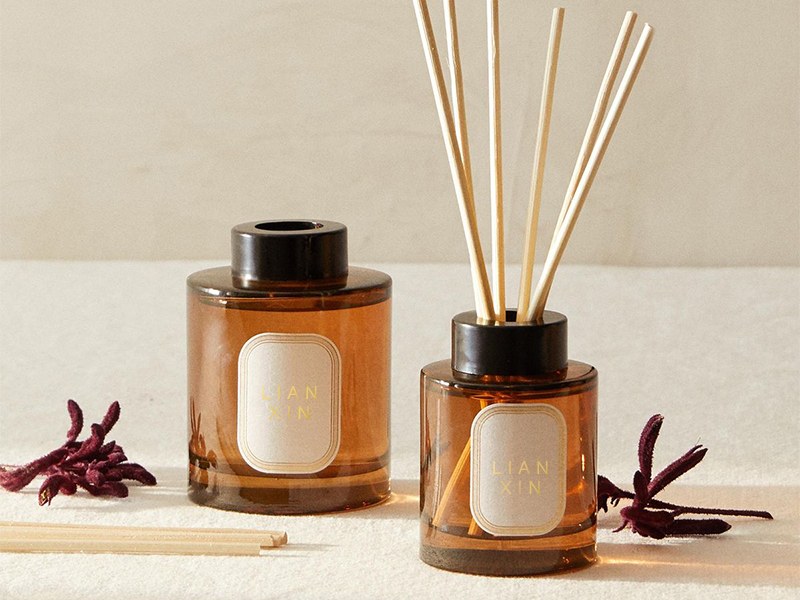
- Amber glass — blocks most ultraviolet and blue light wavelengths, which makes it the safest default for delicate essential oil blends and apothecary-style lines.
- Opaque black glass — achieved by heavy pigmenting or a spray coating; matte black is a strong current luxury signal in home fragrance.
- Green glass — moderate UV protection; often signals a botanical or natural fragrance line.
- Frosted glass — acid etching or matte spray coating. It softens the light, partly conceals the fill level and adds a premium tactile finish.
Sustainability is now part of the same decision. Glass is 100% and infinitely recyclable without loss of quality, and one industry sourcing guide reports that up to 69% of consumers rate glass as the most recyclable and ocean-friendly packaging option. For refill programs, that recyclability story is a marketing asset as well as a compliance one — see our luxury amber oval glass reed diffuser bottles and gradient amber glass reed diffuser bottle for amber options that carry that message without extra decoration.
Reed Diffuser Bottle Sizes: How to Choose 50ml, 100ml or 200ml
Reed diffuser bottles generally run from 50ml to 200ml, with 100ml and 200ml doing most of the commercial volume. The capacity you pick should be driven by room size, fragrance concentration and your target retail price.

| Capacity | Best for | What it gives you |
|---|---|---|
| 30–50ml | Sample and trial kits, travel sets, car diffusers | Lets buyers test a scent without committing to a full-size unit |
| 100ml | Bedside tables, bathroom counters, gift cycles | The gold standard size; a quality 100ml diffuser typically lasts 2–3 months |
| 200ml | Living rooms, open-plan offices, spas and lobbies | Double the value and lifespan for shoppers who dislike frequent replacement |
| 250–500ml | Refill programs, hotels and retail scent contracts | Fewer millilitres of packaging waste per unit of fragrance consumed |
A practical benchmark: a 100ml amber bottle suits bedside tables and bathroom counters, while 200ml suits living rooms and open-plan offices. If your price sits at the premium end but your bottle is 50ml, the value gap costs more than the oil you saved.
Shape matters for logistics as much as for looks. Square and cube bottles give you flat panels for labeling and the best pack density in a shipping carton, which trims freight cost per unit. Round and cylindrical bottles are usually the most cost-effective to produce in high volume because of faster mold cycling and more even glass distribution. For larger or gift-led formats, look at our customizable 200ml aromatherapy glass bottle and the square amber glass reed diffuser bottles with wooden caps.
Neck Finish, Stoppers and Reeds: The Specs Buyers Forget
Most buyer complaints about reed diffusers trace back to the neck, the reed diffuser bottle stoppers and the reeds — three components that are often left unspecified. Reed diffuser packaging commonly uses finishes such as 24/410 and 28/410, which let you match the bottle to a correctly sized diffuser cap. Smaller systems in the 30ml to 50ml range often pair with a tighter neck finish, such as an 18mm thread, and use 4 to 5 thin reeds of around 2.5mm to 3mm.
Component risk check: if the stopper is not matched to the neck, you ship leaks. If the cap does not match the neck thread, your assembled unit will not close. If the reed diameter is too large for the opening, the reeds sit crooked.
| Component | Job it does | Spec to confirm before ordering |
|---|---|---|
| Neck finish | Determines which caps and plugs fit | 24/410, 28/410 or a tight 18mm thread |
| Transit stopper / inner plug | Seals the bottle during shipping | Material, fit to neck bore, removal force for the end user |
| Decorative cap or lid | Brand aesthetics and closure after opening | Neck thread, cap height, wood, metal or plastic finish |
| Collar / ferrule | Clean decorative ring where cap meets glass | Neck outer diameter and ring height |
| Reeds | Capillary action that lifts oil into the air | Diameter, length and rattan versus fiber |
On reeds, material choice changes performance more than most buyers expect. Rattan is traditional but can clog over time, while fiber reeds are a porous synthetic that generally deliver a more consistent scent throw. Specify the reed type together with the bottle so the two are tested as one system — our black glass reed diffuser bottles and cylinder diffuser bottles with black caps ship with matched closures for this reason.
Decoration Options: Frosting, Spraying, Hot Stamping and Screen Printing
Decoration is where a stock bottle becomes your bottle. These methods differ sharply in cost, durability and how much they raise your MOQ.

| Method | Result | Watch out for |
|---|---|---|
| Frosting | Soft translucent finish, hides fill level | Etched and sprayed frosting age differently; confirm the method |
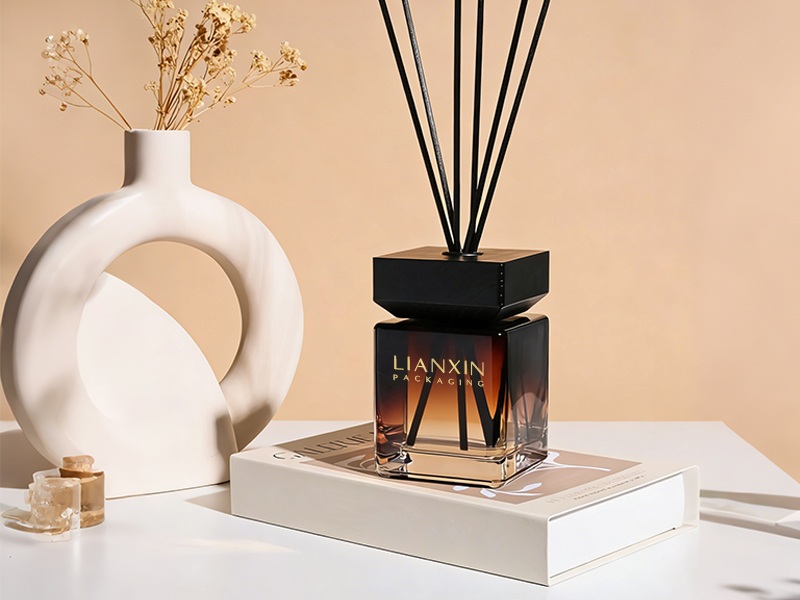
| Spray coating / gradient | Solid or ombré color; matte black is a leading trend | Heavy coating blocks light entirely, so it removes the UV argument for amber |
| Hot stamping | Metallic gold or silver logo, high perceived value | Fine detail and very small type can fill in |
| Screen printing | Crisp one or two colour branding and volume text | Works best on the flat panels of square or rectangular bottles |
| Labeling | Fastest route to a branded unit | Label stock must resist fragrance oil creep and bathroom humidity |
Pair the decoration with the shape deliberately. Square bottles give flat faces that make labeling and screen printing cleaner, and their stack efficiency reduces carton volume. Round bottles carry a gradient more evenly, which is why matte and ombré effects so often appear on cylinders. For a bolder silhouette in your custom reed diffuser bottles range, see the gradient black glass diffuser bottle with a ball cap. The same decoration logic applies to the candle side of a home fragrance line — see glass candle jars.
MOQ, Samples and Lead Times for Wholesale Reed Diffuser Bottles
Reed diffuser bottle MOQ is not one number. Suppliers price three different paths, and each carries its own minimum: stock bottles, decorated stock bottles and custom-mold bottles. Custom shapes that need new mold development command the highest MOQ and the longest lead time, because you are paying for tooling as well as for glass.
| Route | What you get | MOQ and lead time impact |
|---|---|---|
| Stock bottle | An open-mold shape, color and capacity | Lowest MOQ, shortest lead time |
| Stock bottle + decoration | Your branding on an existing shape | Middle tier; add a decoration run to the schedule |
| Custom mold | An exclusive shape no competitor can copy | Highest MOQ; add mold development before production |
| Full kit program | Bottle, stopper, cap, reeds and gift box | Set by the component with the highest MOQ, plus assembly time |
A launch sequence that keeps cash moving: start on a stock bottle with one decoration, prove sell-through, then invest in a custom mold once volume justifies the tooling. Before mass production, approve a stock sample for weight, base stability and cap feel, then a decorated sample for color and logo placement. Those two rounds remove most surprises at the loading stage.
“Ask for the supplier’s MOQ table — stock bottles, decorated stock bottles and custom-mold bottles each carry a different minimum.” That single request is the fastest way to compare quotes that look very different on paper.
Where the Reed Diffuser Market Is Heading
Two shifts are worth building into your next packaging brief. First, refillability. Grand View Research notes that consumers are increasingly choosing diffusers packaged in recyclable materials, and that brands are responding with reusable vessels and biodegradable components. In March 2025, Elemay launched a refillable reed diffuser line, and in the same month ADLAN Fragrances launched a collection in refillable stoneware vessels. A 250ml to 500ml refill bottle sold alongside a reusable 100ml or 200ml primary vessel is now a mainstream format.
Second, regional growth is uneven. Asia Pacific is expected to grow at a 7.3% CAGR from 2024 to 2030, while online retail grows at a 6.7% CAGR over the same window, outpacing specialty stores. The wider home fragrances market is worth USD 15.02 billion in 2026 and is growing at a 6.66% CAGR toward USD 20.88 billion by 2031. If your channel is DTC or marketplace-led, weight your specification toward a lighter, pack-dense bottle and a gift-ready carton — those are the attributes that protect margin when a parcel crosses a border.
Frequently Asked Questions About Custom Reed Diffuser Bottles
What is the most popular reed diffuser bottle size?
100ml is the retail standard and the size most fragrance brands launch with: it suits bedside tables and bathroom counters and typically diffuses for 2–3 months. Move to 200ml for large rooms and commercial settings such as spas and hotel lobbies.
What neck finish do reed diffuser bottles use?
24/410 and 28/410 are the finishes commonly used in reed diffuser packaging because they match a wide range of diffuser caps and transit plugs. Compact 30ml to 50ml bottles often use a tighter 18mm thread.
Do reed diffuser bottles need a stopper?
Yes. A plastic stopper, or inner plug, seals the bottle during shipping and is removed before the reeds are inserted. Specify it with the neck finish, or you risk leaks in transit and a plug too stiff to remove by hand.
Ready to spec your reed diffuser bottle?
Send us your capacity, neck finish, closure and decoration brief. We will reply with matched stock options, a decorated sample plan and an MOQ table for your volume.
Browse the full range of wholesale reed diffuser bottles.
Market data in this guide is sourced from Grand View Research’s reed diffuser market report (2025–2030) and Mordor Intelligence’s home fragrances market analysis. Technical specifications reflect standard reed diffuser packaging practice; confirm exact figures against your approved sample before mass production.