
Quick answer: Perfume sample bottles come in five workable sizes — 1.5–2ml carded vials, 3ml retail testers, 5ml press and influencer mailers, 10ml discovery-set sprays and 15ml travel minis. Fill each bottle to roughly 85–90% of its nominal capacity, match the sprayer to the fill volume, and plan on a 5,000-piece glass MOQ with 15–30 days of bulk production once artwork is approved.
A fragrance lives or dies on a second sniff. Perfume sample bottles are the cheapest way to earn that second sniff — and the easiest place for a brand to lose money through leaking seals, sputtering pumps or a sample that holds 4ml of juice in a bottle sold as 5ml.
This guide covers the sizing, dispensing, fill-volume and MOQ decisions buyers face when comparing wholesale perfume sample bottles — for indie fragrance houses, private-label brands and gifting companies. Every figure comes from published market research or from the specifications Lansenpack quotes on its own lines.

What sizes do perfume sample bottles come in?
Sample formats cluster into five capacities. Below 1.5ml is a novelty; above 15ml it is a travel retail product, not a sample. The table shows practical fill volume for each size — always below nominal capacity, because glass needs headspace.
| Nominal capacity | Typical use | Practical fill | Notes for buyers |
|---|---|---|---|
| 1.5–2ml | Carded vials, magazine inserts, counter strips | 1.2–1.7ml | Lowest unit cost; usually a glass vial with a plastic stopper or a small atomizer |
| 3ml | Retail testers, sampling events | 2.5–2.7ml | Enough for several wears; popular for travel retail testers |
| 5ml | Press kits, subscription boxes, gift-with-purchase | 4.2–4.5ml | See the 5ml perfume tester bottle — the size most brands standardise on for PR mailers |
| 10ml | Discovery sets, e-commerce bundles, travel retail | 8.5–9ml | The workhorse of sampling; a slim 10ml perfume sample bottle fits mailed cartons and gift boxes |
| 15ml | Travel minis, refill sets, layering collections | 13–13.5ml | Borderline between sample and retail; decoration quality matters more here |
As a planning rule, a fine mist pump delivers somewhere between 0.05ml and 0.1ml per actuation depending on stroke length and orifice size. That means a 10ml perfume sample bottle gives roughly 90–180 sprays — a useful figure when you are writing copy like “about 100 sprays per sample”. Confirm the actual dose with your pump supplier before you print any claim on a box.
Shape matters as much as capacity. Slim cylindrical bodies suit pen-style samples and slot into printed sleeves; square and hexagonal bodies give you flat panels for labels and stand upright on a retail counter. Lansenpack’s sample perfume bottle range covers 5ml through 15ml across slim round, rectangular and hexagonal profiles.
Sprayer, vial or dabber: which format suits your channel?
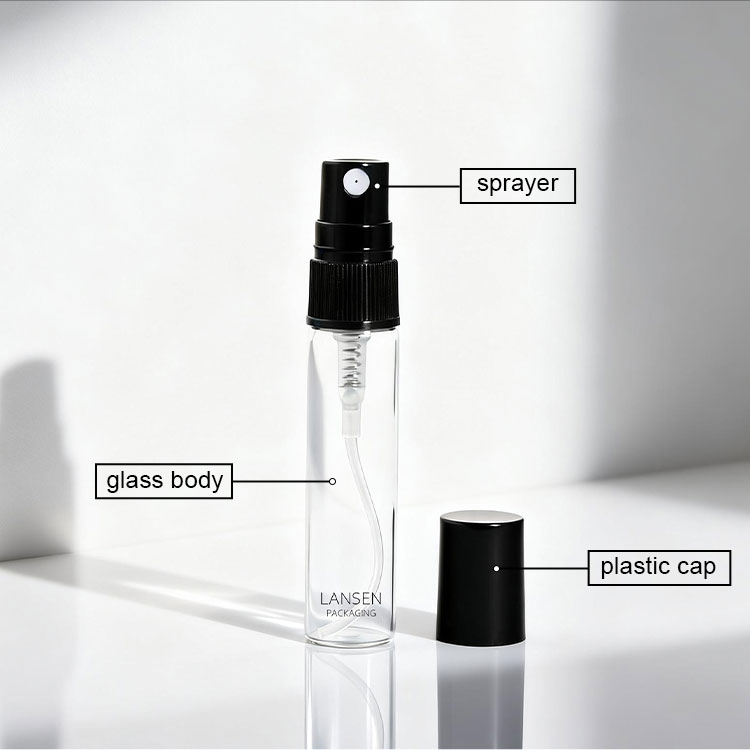
The dispensing format changes both the unit cost and what the consumer experiences. For fragrance sample bottles and retail perfume tester bottles there are four realistic options:
- Fine mist spray (screw-on). The default for 5ml, 10ml and 15ml samples. Refillable, and the most familiar gesture for anyone who already owns a full bottle.
- Fine mist spray (crimped). The pump is sealed onto the neck during filling. Common for sealed retail testers because it cannot be opened, topped up or tampered with in-store.
- Vial with stopper or dabber. Cheapest format at 1.5–3ml, used for carded samples and magazine inserts. No pump to fail, but application is messier and it feels less premium.
- Rollerball. Better suited to oils and attar formats than alcohol-based eau de parfum; the ball and housing add cost and a leak risk that sprays avoid.
For discovery sets, the screw-neck spray is usually the right call: the consumer keeps the bottle and refills it from a full-size flacon. For in-store testers where shrinkage is a real cost, the crimped version is worth the extra assembly step. Mini perfume spray bottles in the 5–10ml range dominate both channels because they ship cheaply and sit neatly in a counter tray.
Neck finish and pump fit
Sample bottles use small neck diameters, and a pump that does not match the neck will either leak or sit proud of the collar. Two examples from current production illustrate the format differences: the 10ml slim glass perfume sample bottle pairs a straight-round body with a clear protective cap, while the 10ml hexagonal refillable sample bottle uses flat facets for label registration. Both are quoted at a 5,000-piece MOQ because both are glass.
How much perfume should actually go into a sample bottle?
Underfilling looks stingy; overfilling causes leaks and returns. For perfume sample bottles the practical band is 85–90% of nominal capacity, leaving 10–15% headspace for thermal expansion and for the displacement of the dip tube.
- Fill by weight, not by eye. Weigh filled units against the target gram figure for your specific fragrance density; alcohol-rich formulas vary enough that volume-only filling drifts.
- Keep the liquid below the shoulder. On slim 10ml formats the shoulder is where the glass narrows, and a full-to-the-shoulder bottle will push liquid into the pump collar when temperatures rise in transit.
- Allow for evaporation. A screw-neck sample can sit in a warehouse for a year and lose measurable volume; crimped closures and tight-fitting caps slow this down.
- Check the dip tube length. A tube that touches the base cannot pick up the last 0.3–0.5ml; one that stops short leaves a visible ring the consumer reads as a short fill.
If your sample is part of a paid discovery set — four 10ml bottles rather than one 30ml bottle, the structure Mintel highlights — fill consistency across your perfume sample bottles matters commercially. Buyers notice when one bottle in a four-pack sits 2mm lower than the others.
Market context for perfume sample bottles
- Global fragrance market: USD 58.9 billion in 2025, projected at USD 61.4 billion in 2026 and USD 89.4 billion by 2033, a 5.5% CAGR (Grand View Research).
- North America held 33.2% of that market in 2025.
- In the US, 25–34-year-olds prefer buying fragrance samples online before committing to a full-size bottle (Mintel, June 2025).
What drives the MOQ and unit cost of custom perfume sample bottles?
Three variables set the quote: whether the mould exists, how the bottle is decorated, and the filling and assembly scope.
| Cost driver | What it changes | Buyer lever |
|---|---|---|
| Existing mould vs new tooling | Tooling fee plus weeks of development | Start from a ready shape and customise colour and decoration first |
| Decoration | Per-unit print, coating and label costs; also MOQ | Silk screen printing and labels are the cheapest routes; hot stamping and gradient coating add cost |
| Pump and cap | Unit price and lead time | Standard clear or black pumps ship fastest; custom colours need their own MOQ |
| Filling and assembly | Labour, QC time and freight weight | Decide early whether you take empty bottles or a filled, labelled, boxed sample |
At Lansenpack the MOQ for perfume sample bottles is 5,000 pieces for glass containers and 10,000 pieces for plastic containers. That threshold is set by the minimum run of the printing and coating lines, not by the glass itself — which is why decoration, not capacity, usually pushes a small brand over budget. If 5,000 is too many for a first launch, use a stock bottle with a single-colour print and save custom coating for the second order.
Labeling and compliance for perfume tester bottles
Sample and tester formats carry the same regulatory obligations as retail bottles, with less surface area to fit them on. Three points come up in almost every project:
- Allergen declaration. EU fragrance allergen labelling rules have been extended, with a transition to 31 July 2026 for placing products on the market and 31 July 2028 for withdrawal (Grand View Research, citing IFRA). On a 10ml bottle that declaration can consume most of the label — plan the layout before choosing the shape.
- Tester marking. Retail testers should be marked as testers (or “not for sale”) so they are not confused with sellable stock during audits or customs checks.
- Batch traceability. A batch or lot code on the base or label is what lets you trace a complaint back to a filling run. On small formats this is usually a small inkjet code on the base rather than printed on the label.
If you are building a discovery set, keep mandatory text in the same position on every bottle. Mismatched label positions across a four-bottle collection is one of the most common reasons a set fails retail QC.
QC checklist before you approve bulk

Run these checks on your perfume sample bottles at pre-production and again at bulk AQL inspection:
- Fill weight against the agreed gram target, sampled across the run rather than from the first carton.
- Spray pattern and dose — no jetting, no dripping, consistent output across 10 consecutive actuations.
- Leak test with bottles inverted and upright over 24–48 hours at ambient and elevated temperature.
- Actuation force, especially on crimped testers where a stiff pump reads as a defective product on the counter.
- Cap retention — the cap must stay on through a drop test, not fall off in the carton.
- Glass appearance — seeds, blisters, mould seams and chill marks on the visible panel.
- Decoration adhesion — tape pull and rub tests on print, hot stamping and coating.
- Label registration — position and rotation within tolerance on every unit in the set.
Ask for the inspection report with photographs, not a pass/fail line. An AQL result without images tells you someone looked; it does not tell you what they saw.
How to brief a sample bottle supplier and what to plan for
A brief that gets an accurate quote for perfume sample bottles first time includes: capacity and fill volume, fragrance type (alcohol-based or oil), pump type, cap finish, decoration method, label dimensions, target channel and annual volume. A reference photo plus a capacity is enough to shortlist moulds, even without a technical drawing.
On timing, use these ranges from Lansenpack’s standard schedule as your planning baseline: samples in 3–15 days, bulk production in 15–30 days after approval, then 4–5 weeks by sea or 1–2 weeks by air. A launch that needs samples, a revision round and sea freight is realistically a two-to-three-month project, so start before the artwork is finalised rather than after.
Where to start: browse the sample and tester bottle collection, shortlist two shapes, then match them against the full-size perfume bottle range so the sample reads as a smaller version of the retail bottle. Coordinated shapes across sample and full size make a discovery set feel designed rather than assembled. For 15ml travel-retail formats, the 15ml gradient glass perfume spray bottle shows how coating and printing behave on a larger sample body.
Sources: Grand View Research — Fragrance Market Size, Share & Trends Report, 2026–2033; Mintel — Social Media Fuels Fragrance Sampling as Gen Z and Gen Alpha Seek Affordable Prestige (June 2025).
Manufacturing figures (MOQ, fill tolerances, production and freight windows) reflect Lansenpack’s current quotation standards; confirm them against your own specification sheet before ordering.
Ready to spec your perfume sample bottles?
Send your capacity, fragrance type and decoration idea — we will come back with a 3D rendering, a unit price and a sample lead time.