
Quick answer: roll on bottles are small liquid containers that dispense product through a captive ball held in a snap-fit housing, so the formula is applied by contact instead of spray or drip. The three specifications that decide whether your run succeeds are capacity (3ml–10ml for oils and perfume, 50ml–75ml for deodorant), ball material (stainless steel, glass, plastic or ceramic) and the tolerance between ball and housing — because that gap, not the bottle body, is what controls both dose and leakage.
Roll on bottles sit in an awkward spot for buyers: they look simple, they are cheap per unit, and almost every failure mode is invisible until a customer carries one in a handbag. The format is also growing faster than most packaging categories. The global deodorant roll-ons market was valued at $8.5 billion in 2025, is estimated at $9.0 billion in 2026, and is projected to reach $16.1 billion by 2036 at a 6.2% CAGR, with antiperspirant roll-ons alone accounting for 38% of product type sales in 2026 (Future Market Insights). Add essential oil blends, perfume oils, attar, eye serums and spot treatments and the installed base of roll on bottles gets very large indeed.
This guide covers the specification decisions that actually matter: which capacity belongs to which product, how ball materials behave with real formulas, what MOQ a custom roll-on programme implies, and how to test for leaks before you commit to mass production.
What Are Roll On Bottles?
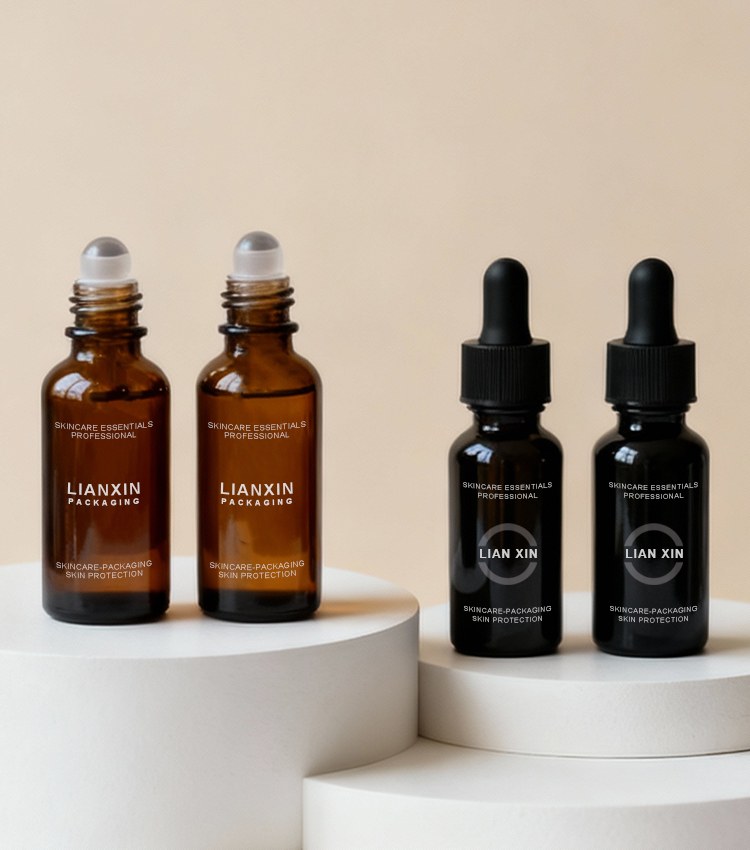
Roll on bottles are containers with a spherical applicator seated in the neck: a ball is pressed into a plastic housing that snaps or screws onto the bottle, and capillary action plus the rolling motion transfers a thin film of product onto skin. There is no pump, no propellant and no orifice to block, which is why the format survives in categories where metering is not critical but portability is.
Structurally, a roll-on is a four-part assembly rather than a single item: the body (glass or plastic), the ball, the housing or fitment that retains the ball, and the overcap. Every one of those parts has its own tolerance band, and the assembly only works when they are matched. Suppliers who quote “roll on bottle” as one line item are usually describing a stock combination that has already been fitted and tested — a distinction worth confirming early, because a mismatched housing is the single most common cause of a leaking roll-on programme.
The commercial logic of the format is straightforward: a roll-on dispenses by contact, so the ball does two jobs at once — it meters the dose and it delivers the product. That is also why the ball material is a formulation decision, not a decoration decision, and why the leak-proof roll ball and cap configuration matters for anything sold online or shipped by air (A Packaging Group).
Roll On Bottle Sizes: 3ml Essential Oil to 50ml Deodorant
Capacity is driven by dose per application, not by aesthetics. Oils and perfume are applied in fractions of a millilitre, so the bottles stay tiny; deodorant needs a broad, wet application, so the bottles grow. Common roller bottle sizes are 3ml, 5ml, 10ml, 15ml and 20ml, with 10ml the de facto standard for essential oils and 5ml used widely for perfume samples and travel SKUs (SmileBottles). Chinese stock programmes typically offer 4ml, 5ml, 6ml, 8ml and 10ml in clear, amber, blue and frosted finishes, with stainless steel balls as standard (JL Glass).
| Capacity | Typical product | Body | Why this size |
|---|---|---|---|
| 3ml–5ml | Attar, perfume oil, sample | Glass | Concentrated dose, purse and travel format |
| 8ml–10ml | Essential oil blends, spot treatment | Glass, amber or frosted | Industry default; fits standard fitments |
| 15ml–20ml | Face serum, under-eye, lip oil | Glass or thick-wall plastic | Enough for a 4–6 week routine |
| 50ml–75ml | Deodorant, antiperspirant | Glass or HDPE/PET | Body-wide application, monthly consumption |
Two size-related traps are worth flagging. First, nominal capacity and fill volume differ: a “10ml” body is usually filled to 8–9ml to leave headspace for the ball and housing. Second, the neck finish — the thread and bead geometry — determines which fitment fits, so a 10ml bottle from one mould may not accept another supplier’s housing even though both are sold as 10ml roll-ons. Specify the neck finish, not just the capacity.
Roller Ball Materials: Stainless Steel vs Glass vs Plastic vs Ceramic
Stainless steel is the industry workhorse because it is durable, corrosion-resistant at the right grade, and gives a slight cooling sensation on contact — the reason it dominates essential oil, perfume and eye-serum formats. The critical qualifier is grade: 304 or 316 stainless handles most essential oils well, while lower grades can react with acidic or citrus-heavy blends over time.
Glass balls are chemically inert, so they suit pure essential oils and clean-beauty claims where purity is the selling proposition, and they pair naturally with amber or frosted bodies. They are more fragile in transit. Plastic balls are the budget route for mass-market deodorant, where cost outranks feel — but plastic can degrade with strong oils or high-alcohol fragrances, and low-grade plastic can leach into the product under heat, with micro-scratches that harbour bacteria. Ceramic sits at the premium end for sensitive-skin positioning: non-porous, cool to the touch and compatible with oils, serums and deodorants, at a higher unit cost (MGG Group).
| Ball material | Strength | Watch out for | Best for |
|---|---|---|---|
| Stainless steel | Durable, cooling, smooth glide | Grade must match formula | Essential oil, perfume, deodorant |
| Glass | Chemically inert, premium look | Fragile in e-commerce transit | Pure oils, clean beauty |
| Plastic | Lowest cost, lightweight | Leaching, oil and alcohol attack | Mass-market deodorant |
| Ceramic | Non-porous, cool, no leaching | Higher unit cost | Sensitive-skin deodorant, serum |
Whichever you choose, keep the spec explicit: “stainless steel ball” without a grade is not a specification, and it is the difference between a stable formula and a discoloured one at month three. Stock programmes that pair a known glass body with a known steel ball — such as our 12ml refillable attar bottles with a metal roller ball — remove most of that risk because the assembly has already been fitted and tested together.
Matching the Ball to the Formula
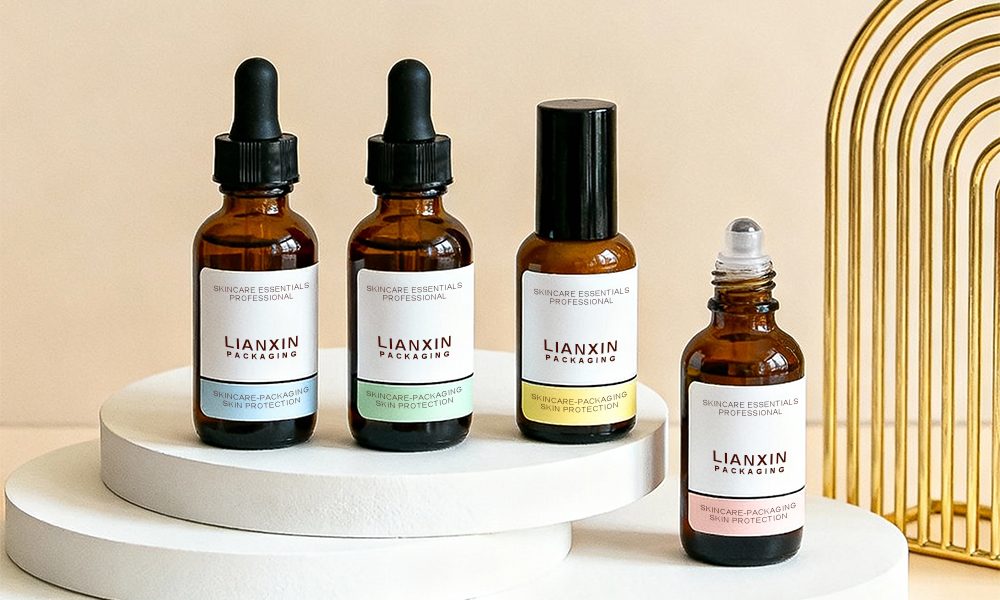
Viscosity decides glide. A thin alcohol-based perfume oil wicks through a tight ball-and-housing gap and can over-deliver or weep; a heavier oil blend needs a looser fitment or it drags. The practical approach is to treat the ball and housing as a matched pair and to test with the real formula rather than a surrogate — suppliers recommend a stability test of at least 30 to 60 days with your actual formula before a bulk order, precisely because citrus and cinnamon-heavy oils are aggressive enough to degrade lower-grade metals and some plastics.
Alcohol content is the second axis. Perfume roll-ons are usually alcohol-based, which rules out most low-grade plastics; steel and glass both work. Deodorant roll-ons split by positioning: mass-market formats commonly use plastic balls, while natural and organic brands upgrade to glass bodies with steel balls to support a cleaner story. Eye serums and de-puffing products lean on the cooling sensation of steel, where the cold feel is part of the product benefit.
Finally, consider decoration early, because roll-ons are small and the print area is unforgiving. Screen printing and hot stamping both work, but on a 5ml body the artwork window is narrow, and a bare ball housing leaves less clearance than brands expect. Some formats solve this with an applicator rod instead of a ball, as in our 3ml vintage Arabic perfume bottle with a glass applicator rod — a different dosing mechanic with its own appeal for oud and attar lines.
What Is the MOQ for Custom Roll On Bottles?
Roll-ons are friendlier on MOQ than most cosmetic formats because the body, ball and housing are separate components: you can buy a stock body, a stock fitment and a stock ball, then customise colour and decoration, and reach a much lower entry quantity than a moulded bottle requires. The MOQ that matters commercially is usually the housings and balls, which are moulded or purchased in fixed packing quantities, and the frosting or printing runs, which carry their own minimums.
If you need a genuinely proprietary body — a shape nobody stocks — you are back into custom mould territory and the volume expectation rises sharply. The decision tree is therefore: stock body plus custom decoration (lowest entry), stock body plus custom colour (mid), or custom mould plus custom fitment (highest, and only sensible at multi-tens-of-thousands volumes).
What drives roll-on cost per unit
- Ball material and grade — plastic < standard steel < glass < ceramic
- Housing tolerance quality — the hidden line item that decides leak rate
- Body material — glass versus HDPE or PET
- Decoration — label < screen print < hot stamp plus frost
- Assembly — fitted and tested by the supplier, or shipped as loose components
Leak Testing and QC Before Mass Production
Because a roll-on is an assembly, inspection has to cover the interfaces. Four checks catch most of what goes wrong:
- Ball retention. The ball must spin freely but not fall out under normal cap removal and drop. Ask for the housing retention spec in writing.
- Leak test in the shipping orientation. Invert and shake, then hold at 40°C for a defined period — heat is what turns a marginal fitment into a soaked carton. Suppliers in this category typically run documented leak tests per batch, and you should ask to see the procedure rather than the promise.
- Dose consistency. Roll a fixed number of strokes on a defined substrate and weigh the delivered mass across at least ten bottles. Variation here is the earliest signal of a housing out of tolerance.
- Formula compatibility over time. Fill, cap, store 30–60 days, then check for ball corrosion, plastic crazing and colour drift — not just leakage.
The regulatory tail is worth planning for too. EU Regulation (EU) 2025/40 applies from 12 August 2026, with packaging minimisation obligations phasing in on their own timelines, and 55% of surveyed consumers say they want refillable or recyclable options — which is why refillable roll-on designs are appearing in the same brief as leak performance. A refillable roll-on adds a second sealing interface, so it must be leak-tested in both the filled and the refill state.
Specifying Your Next Roll-On Run
The format rewards precision and punishes assumptions. Fix the four decisions in order — capacity from dose, ball material from formula and positioning, housing and neck finish from the body, decoration last — and the cost and MOQ conversation becomes straightforward instead of iterative.
If you are working on a perfume oil, attar, essential oil blend or deodorant programme, we can match a stock body to the right ball and fitment and send a filled sample for your own stability test. Reference builds to compare against include the 6ml crown glass roller bottle for essential oil and the 8ml purple-gold luxury roller bottle, both drawn from our wider glass bottle range.